Megamind Peeking
This meme is missing some context. Know more? Add it — your name stays on it.
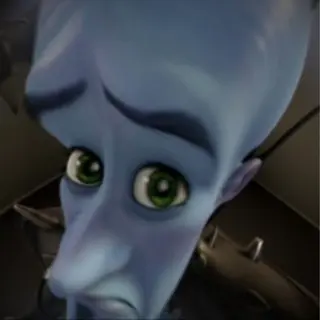
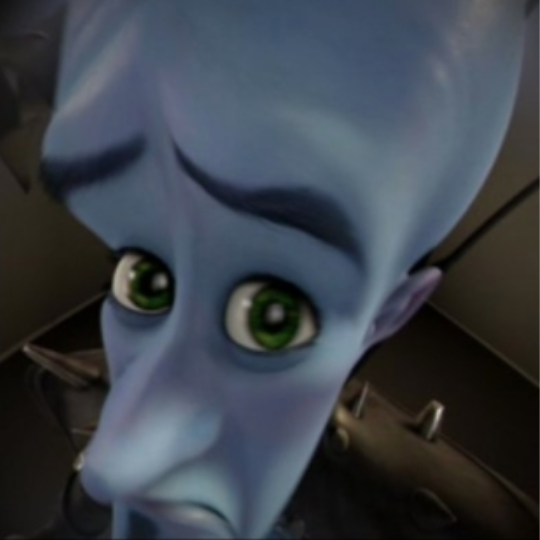
Cropped close-up of Megamind, the blue DreamWorks supervillain (2010), peeking his eyes over a surface. Reaction format used to highlight the frustrating absence of an expected element: "No X?"
The image comes from the DreamWorks animated film Megamind, released in theaters on November 5, 2010, directed by Tom McGrath and voiced by Will Ferrell in the title role. The screencap isolates a close-up shot of the protagonist during one of the scenes in the film's final act, where the character observes the outside world, revealing only the top of his skull and his wide eyes above a horizontal border — an ideal composition for use as a reaction image, which is the template's main value.
Where does this meme come from?
The image template has been circulating in isolated form since the early 2020s. The reference copy used by the Imgflip community — i.imgflip.com/64sz4u.png — is hosted on the mainstream generator Imgflip, a platform that serves as a de facto archive for templates shared in chains on Reddit, Discord, and Twitter. The screencap's popularity relies on a very specific framing characteristic: the empty space above the character offers a natural place to overlay a question starting with "No," making it an ideal vehicle for snowclone rhetoric — a fill-in-the-blank phrase reused identically with a variable word.
How did it spread?
Starting in 2021, the format spread massively on r/MemeTemplatesOfficial and the dedicated subreddit r/MegamindPeekingMemes, the latter serving as a coordination point for variations of the formula. The subreddit surpassed hundreds of thousands of subscribers and functions as a collective laboratory where each post applies the "No X?" structure to a new referent: video game titles, app features, community inside jokes. The format saw a marked resurgence in early 2024 when the screencap migrated to TikTok, where it was integrated into short montages about everyday frustrations — missing products on shelves, absent software options, expected features on social platforms. Variants found on aggregators include non-English language versions, where the "No X?" formula is translated literally or adapted locally, a sign that the visual grammar of the peek transcends the original language.
What does it mean?
The template's lasting success is due to a rare expressive economy: the character occupies barely a third of the image, maximizing text space while retaining a strong emotional signifier — curiosity tinged with disappointment. The "peeking" position suggests anticipation, hope, immediately contradicted by the question posed above. This rhetorical structure functions as a mini-narrative in two steps: the eye searches, the sentence notes the absence. This is why the format has colonized technical and community discussion threads, where users frequently request missing features or point out vexing omissions [reading].
Unknown
EN