Distracted Boyfriend
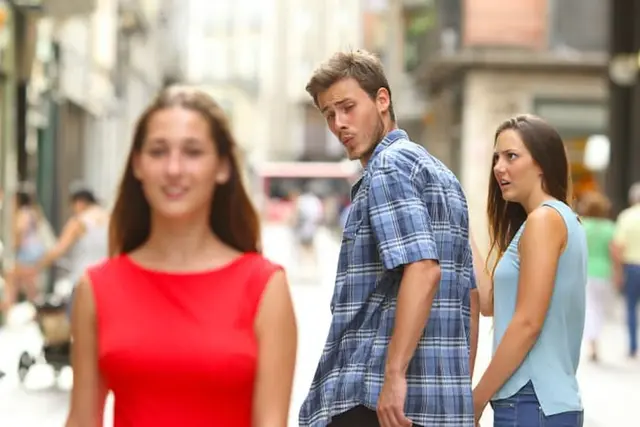
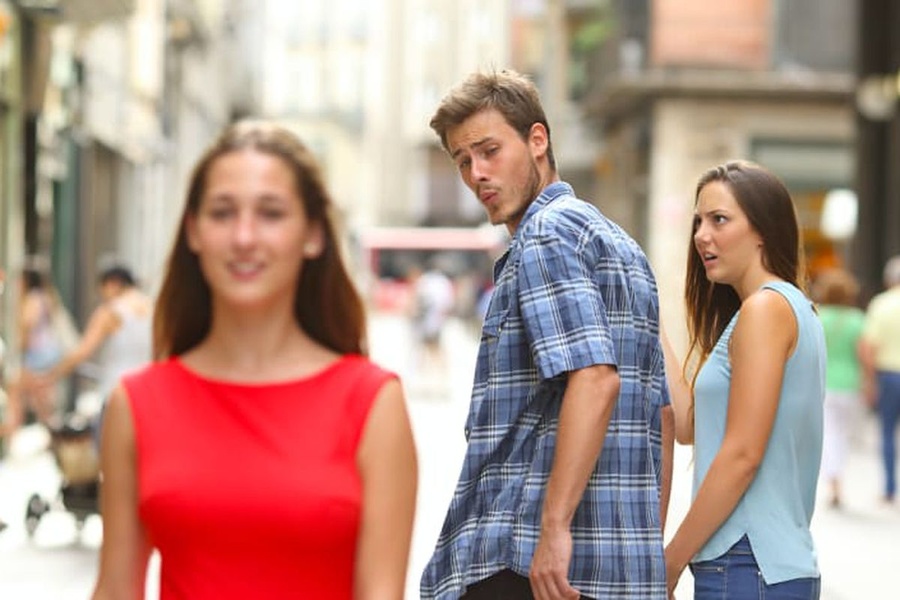
Stock photo by Antonio Guillem (2015) showing a man turning to look at a passerby while his partner looks on in outrage. In 2017, it became the universal visual metaphor for temptation and unfaithful choice.
Where does this meme come from?
The photograph was taken in 2015 by Spanish photographer Antonio Guillem and published on Shutterstock and iStock under the original title “Disloyal man walking with his girlfriend looking amazed at another seductive girl”. The complete series features the same three models — a dark-haired man in a checkered shirt, his visibly shocked dark-haired partner, and a young red-haired woman he stares at while turning around — in a typical stock photo choreography illustrating the concept of infidelity.
The image first circulated discreetly in online press articles and lifestyle blogs. In January 2017, a Turkish Facebook page dedicated to progressive rock (“Phil Collins / Genesis / Peter Gabriel”) posted the photo, altered to illustrate “rock prog” cheating on “rock pop” with “metal” — the first documented instance of the format as a generic metaphor for temptation.
How did it spread?
On August 22, 2017, a Reddit user posted a variation in r/MemeEconomy with the prediction “Distracted Boyfriend will become the new Dr. Phil”: this is when the format adopted its canonical three-label structure (desired object / central character / neglected object). Twitter and Facebook seized upon it shortly after, and The Guardian published an article at the end of August about the photographer and his reaction to the unexpected virality of his photos.
The format's success prompted Antonio Guillem to publish new photos from the same series with different combinations — the girlfriend distracted by another man, the husband distracted by a car — commercially capitalizing on the acquired notoriety. In 2018, the Swedish Advertising Council censored a poster by the operator Bahnhof using the meme for its sexist nature, ruling that it “objectifies the red-haired woman”. The format became one of the most enduringly productive of the 2010s, recycled to comment on politics, technology, sports, and pop culture.
What does it mean?
The meme works because it condenses three simultaneous affects into one image — desire, betrayal, indignation — each embodied by a distinct character whose posture is readable without a caption. Its plasticity stems from abstraction: the three figures can represent any triangle between a subject, their current loyalty, and their temptation, making it a tool for political and cultural analysis as effective as a diagram. The original photograph, conceived as an unpretentious commercial shot, thus becomes a true linguistic sign in the semiotic sense.
2017
en